

Increased Stock Volumes in 40% Less Warehouse Space
Increased Stock Volumes in 40% Less Warehouse Space
Warehouse Management Software Enables Increased Stock Volumes in 40% Less Warehouse Space
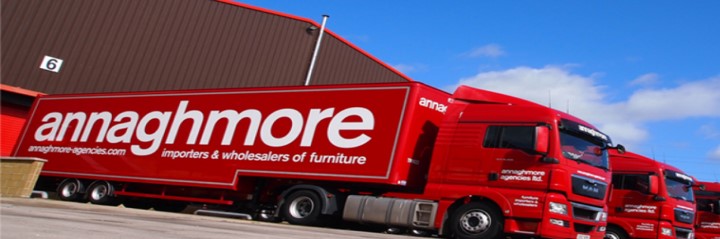
 Established in 1977, Annaghmore Agencies (Annaghmore) is Ireland’s leading furniture importer and wholesaler. An Irish owned family business, the company distributes its products throughout the UK and Ireland. Based near Portadown, Co Armagh, Ireland, Annaghmore strives to consistently deliver market leading products that are innovative, creative and above all competitively priced.
Products are sourced from the world’s leading furniture manufacturers and are prepared for distribution at Annaghmore’s state-of-the-art 200,000 sq. ft. purpose-built warehouses. The extensive product portfolio includes dining, living and occasional furniture through to bedroom furniture and lighting. The company stocks over 2,000 product lines and aims to deliver within 15 working days.
About Annaghmore
- Ireland’s leading furniture importer and wholesaler
- Manages 1,000+ regular customers & over 2,000 products
- Supplies quality dining, living, occasional bedroom furniture & lighting
- Assembles furniture onsite prior to despatch
- Manages the receipt, storage and delivery of over 500 containers annually
Warehouse Management: Situation and Challenges
 Annaghmore selected ProWMS Warehouse Management Software to address multiple business challenges. On engagement the company was using a mix of its own storage and local 3PL third-party storage providers. Stock issues were particularly troublesome as many customer orders contain multiple items stored in different warehouse locations. This caused inefficient picking leading to customer delivery errors and delays which had to be addressed quickly.
To improve customer service Annaghmore had decided to build an innovative 200,000 sq. warehousing facility at its headquarters location in order to centralise operations at a single site.
Annaghmore Business Challenges
- Inefficient picking due to multiple products per customer order causing customer delivery errors & delays
- Reliance on a paper-based system proving inefficient, costly & a barrier to growth
- Lack of stock movement history data for stock management optimisation
- Managing varying product sizes – larger pieces requiring specialised handling equipment &
dedicated racking types - Stock arriving without barcode labelling causing handling, storage & incorrect item shipping errors
- Forklifts & drivers returning back empty 50% of the time
- Related orders or transactions within Microsoft Nav not consolidated
 “All boxes look similar in a furniture warehouse so identification by sight alone is inefficient. With one of the largest product portfolios in the market we urgently needed a system that allowed for, and managed, more stock in less space. It needed to integrate with our Microsoft NAV ERP sales order processing and stock management systems enabling us to deliver on our longstanding excellent customer service levels and to drive ROI and future growth.”
Conor McKeown, General Manager, Annaghmore Agencies
 The company had operated Microsoft Dynamics NAV for its ERP and SOP systems but this technology had already hit some warehousing limitations and a paper-based system was proving inefficient, costly and a barrier to growth.
Other complications included a lack of stock movement history data. The varying sizes of products being managed spans table lamps, beds and suites of furniture. Larger pieces need specialised handling equipment and dedicated racking types.
Annaghmore receipt, store and distribute over 2,000 products which are sourced globally and it handles over 500 containers annually. The extensive product portfolio includes dining, living and occasional furniture through to bedroom furniture and lighting. The varied size of items and range of suppliers consequently throws up some unique warehousing challenges.
Deliverables and Results
Item Identification, Sizing and Barcode Labelling
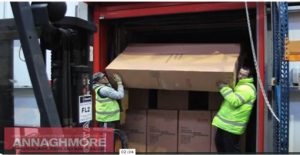 Most items arrive at the warehouse without a scannable barcode label. Clear identification and labelling was required upon receipt to prevent subsequent handling, storage and shipping errors, such as shipping the incorrect colour etc.
Purchase orders, managed in MS Dynamics Nav, included the original order information to line level. We engaged with the MS Dynamics supplier to ensure each new product record included a barcode, and that each would be categorised into one of a number of pre-determined industry size categories (e.g.: Euro Pallet Standard height, Euro Pallet Double Height, Double Euro Standard Height, etc.).
Physically, when a product is receipted, this is now done against the purchase order, which is interfaced to ProWMS. The WMS now generates a barcoded label containing the pre-determined size and category. This barcoded label, once scanned, directs the putaway operator to the correct zone and location for the item.
 “As the warehouse had not yet been built, we experienced the luxury of helping to plan operations for a new, empty warehouse. This meant that we could configure ProWMS functionality to fully optimise available space and assist Annaghmore with the racking configuration to accommodate varying sizes, heights and weights of stock, matching these for efficient putaway, replenishment and picking rules.”
Adrian Jennings, Professional Services Manager, Principal Logistics Technologies
Warehouse Zoning
 Warehouse operatives are now zoned. Different user groups are associated with varying handling equipment and only work relating to their zone appears on their handheld device screens.
The zoning logic is first by warehouse, then by handling equipment and finally by experience. This means that instructions are firstly zoned by the physical warehouse the operator is in. After this the operator is only presented with work based on the equipment type that they could operate (e.g.: standard forklift vs. special side loaders for larger pieces), and finally by user experience which allows some operators to only work in lower locations and more experienced operators to operate at higher locations.
“Pre ProWMS we required over 200,000sq feet to operate. We now handle increased volumes but are operating at 120,000 sq. feet, which would have been impossible without ProWMS. If you factored the above into your efficiencies gains, we would have seen optimisation well in excess of 25%.”
Conor McKeown, General Manager, Annaghmore Agencies
Two Phase Interleaving of Putaway, Replenishments and Picking for VNA locations
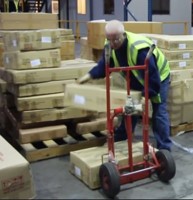 To maximise space Annaghmore had opted for Very Narrow Aisle (VNA) racking systems for part of its warehouse. ProWMS putaway algorithms now direct the forklift drivers to optimised locations based on a set of system directed putaway rules.
Stock in Very Narrow Aisle locations requires a two-phase putaway. A standard forklift driver is notified to locate the stock at the end of the required Very Narrow Aisle. They then scan the product barcode, locate the stock at the end of the required aisle and then scan a barcode location label at the end of that aisle. This scan triggers a work request to the VNA forklift driver that there is stock awaiting putaway. The VNA driver scans the product barcode and this directs them to the pre-determined VNA location.
A similar two-phase picking regime follows the same logic but in reverse. We have also included stock replenishments into this workflow.
Consolidation of Sales Order Transactions
 Another significant benefit delivered by the ProWMS deployment was consolidation of picks.
With over 1,000 regular customers, more than 2,000 product lines and its own fleet of vehicles delivering throughout the UK and Ireland in under 15 working days it is commonplace that customers place additional orders before picking or shipping commences.
Previously, this had caused problems as different orders or transactions within Microsoft Nav could not be consolidated. This required considerable manual administration to consolidate orders in pick sequence. An improvement was business-critical as items missed would result in additional delivery costs along with poor customer satisfaction levels.
As sales order transactions are added within Microsoft Nav, ProWMS functionality consolidates multiple sales orders automatically reducing administration effort, eliminating errors, lowering transport charges and increasing customer satisfaction by improving order fulfilment rates.
“Many WMS systems assign operators a single function, be it putaway or extraction, and as such miss the opportunity of dual cycling, often leaving a forklift and driver returning back empty 50% of the time which is not an optimised process”
Adrian Jennings, Professional Services Manager, Principal Logistics Technologies
WMS Warehouse Management Software Results
ProWMS Warehouse Management Software delivered many valuable business benefits, optimising stock movement and operator performance in this busy high-volume warehouse operation.
- Optimisation enables increased stock volumes in 40% less warehouse space
- Efficiencies over 25% achieved & order fulfilment rates boosted
- Damages & transport costs reduced
- Order picking errors eliminated resulting in increased customer satisfaction
- Real-time business information available leading to improved decision-making
- Improved delivery accuracy resulting in less returned stock
ProWMS drives customer satisfaction…
“Before ProWMS, even with the larger warehouse space, when we reached 70% capacity we hit inefficiencies. Now operating ProWMS even with 40% less space, we only see these same inefficiencies when we are operating above 95% capacity”.
Conor McKeown, General Manager, Annaghmore Agencies
 New report reveals major growth and seismic changes in UK warehousing sector:
A new report into the size and make up of the UK warehousing sector, commissioned by the UK Warehousing Association (UKWA) and produced by Savills, has highlighted major growth in the sector and seismic shifts in occupier profile over the last six years. Continue reading…
Previous Article
We're growing: Two senior management appointments announcedNext Article
FMCG & Grocery Warehouse Management




Registered office address: 3 Ongar Square, Ongar Village, Dublin 15 D15 H34C.